Immaculata News
Two Immaculata University Students Gain Skills in Summer Research Project at the Florida Museum of Natural History
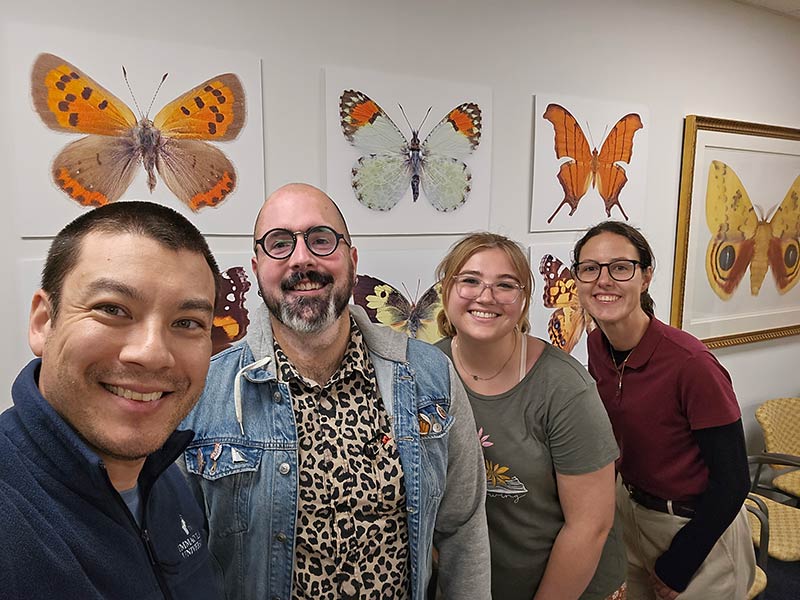
Two Immaculata University students spent part of their summer in Florida gaining hands-on research experience digitizing New Jersey butterfly specimens at the University of Florida.
Seniors Mary Steinbicker, a biology with secondary education major, and Grace Wright, a double major in chemistry and biology, joined Immaculata Associate Biology Professor Stephen C. Mason Jr., Ph.D., at the McGuire Center for Lepidoptera and Biodiversity at the Florida Museum of Natural History. The McGuire Center is operated and managed by the University of Florida. They worked alongside Vaughn Shirey, Ph.D., one of the center’s assistant curators.
Home to one of the largest butterfly and moth collections in the world — about 12 million specimens representing 90% of known species — the McGuire Center provided an ideal setting for the students to immerse themselves in meaningful research.

Over three days, Steinbicker and Wright learned to digitize New Jersey butterfly specimens — a process that required both technical skill and patience. First, they carefully mounted each delicate specimen under a high-resolution camera, arranged its associated labels so all the label information was included in the photo, then photographed both dorsal (back) and ventral (front) sides of the butterfly. Once photographed, the images and label data, such as collection location, date, and collector, were entered into a digital spreadsheet.
Working with precision and care, they processed over 600 specimens representing eight of New Jersey’s estimated165 known butterfly species. The resulting high-resolution images and detailed metadata will be made available to researchers worldwide.
Mason said that the project not only expanded the students’ technical abilities but also gave them a clearer picture of the opportunities and expectations they might encounter in their future careers. More importantly, he noted, it gave them first-hand experience conducting research at another institution and participating in a real project, which he added, “was well beyond the scope of an undergraduate class assignment.”
“Grace and Mary observed how Dr. Shirey and I work together as colleagues, developed an understanding of professional research culture at the McGuire Center, and experienced the importance of building professional networks,” Mason said. “Along the way, they discovered that science can be both rigorous and enjoyable, and that travel is often an essential part of a scientist’s career.”
For Steinbicker, the collaboration with the research team and exposure to a fully functioning laboratory were highlights. Planning to become a teacher, she said the character skills she gained will be as valuable as the technical skills.
“I’m always looking for real-world experience I can bring into my classroom, and now I have another area that I can speak to from personal experience.”

Wright joined the project in part because she wanted to work with Shirey, who had previously visited her Ecology & Biodiversity Immaculata class to guest teach about coding and statistical analysis. With interests in statistics and chemometrics, she recognized that the project will give her more experience to further develop these relevant skills at an R1 research university — a classification for institutions with “very high research activity.”
Beyond the research, Wright said the trip gave her clarity about her plans to attend graduate school and pursue a career as a principal investigator. It also solidified her interest in mentoring future students.
Mason emphasized that the project’s value went beyond the scope of science.
“Experiences like these, learning and exploring in real time, often leave a stronger and more meaningful impression than hours spent in lectures, studying, or taking exams that we may never remember. This trip provided Grace and Mary with moments that are both educational and unforgettable, highlighting the true value of immersive learning experiences.”