Immaculata News
Making Money Moves: What You Should Know About Money Now
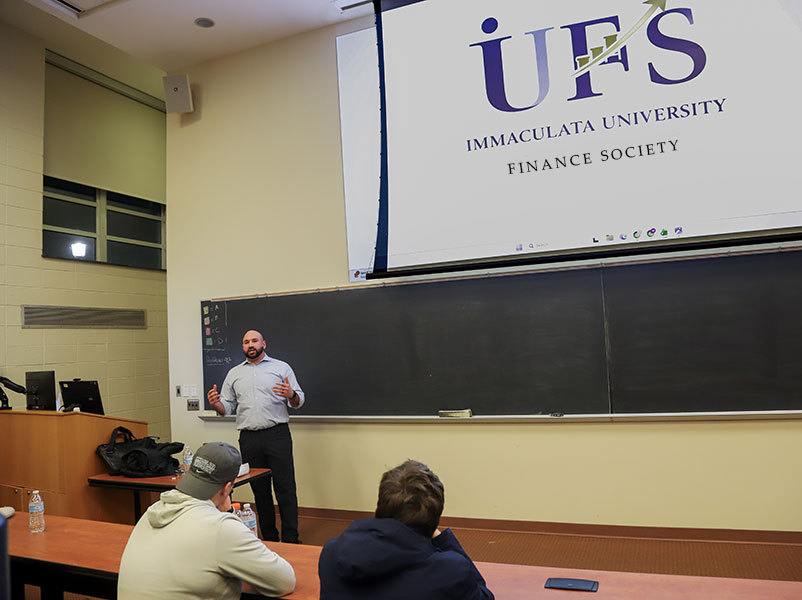
Immaculata University Finance Society recently hosted its first-ever event where faculty mentor Elizabeth Faunce welcomed a familiar face back to campus: 2013 graduate Dan Klodarska, a former lacrosse player and finance major, who now serves as a managing director at State Street, an American investment management division of State Street Corporation, the world’s fourth largest asset manager.
Returning to his alma mater, Klodarska shared practical insights on careers, investing and building long-term wealth. His message resonated not only with students preparing to enter the workforce, but with anyone seeking to make informed financial decisions at any stage of life.
He began with a candid message about starting out in the workforce. Many graduates entering the finance industry, he said, may begin making around $35,000. “That doesn’t sound great,” he admitted. But that first salary is not the finish line; it’s a foundation. The first three months on the job should be about learning your role thoroughly. After that, the focus shifts to understanding how your role fits into the larger organization and being able to clearly articulate why your work matters.
Around 18 months in, he suggested, it’s reasonable to look for your next promotion or role and begin having those uncomfortable conversations about salary and advancement. Career growth requires initiative. He also underscored the importance of relationships. One of his early opportunities at State Street stemmed from helping a fellow IU student pass accounting. That classmate later remembered Klodarska and helped open the door to further professional advancement. The experience served as a reminder that classmates and peers can become long-term professional connections.
As his career progressed at State Street, Klodarska paid attention to where the firm was allocating capital. When State Street acquired a global, cloud-based provider of front- and middle-office investment management solutions serving asset owners, insurers and wealth managers in a $2.4 billion deal, he recognized that leadership would focus heavily on that platform. He moved toward that growth area early, a decision that helped shape his trajectory toward vice president and eventually managing director. His advice was straightforward: look at where investment and resources are flowing—in the broader economy, within your company and inside your department—and position yourself in that growth area.
Klodarska also pulled back the curtain on part of his current world: exchange-traded funds (ETFs) and mutual funds. At a high level, ETFs and mutual funds can hold similar underlying assets such as an S&P 500 portfolio. The difference is structural. Mutual funds are priced once per day after markets close and certain transactions can trigger capital gains distributions. ETFs trade throughout the day like stocks and use authorized participants for share settlement, which can help avoid some of those capital gains distributions. In many broad index funds, the difference between providers often comes down to fees and structure rather than dramatically different holdings.
He then turned to what he described as his second favorite topic: personal finance and wealth creation. Building wealth, he explained, comes down to two key factors: margin and time. Margin is the gap between what you earn and what you spend. While budgeting may not be glamorous, understanding your inflows and outflows is foundational to financial stability and long-term growth. Time, however, is also an extraordinary advantage young people possess. He described students as “billionaires of time,” emphasizing that early contributions benefit enormously from compounding.
Using a 4% withdrawal framework, he illustrated that someone who wants to live on $65,000 per year in retirement would need approximately $1.625 million in today’s dollars to sustain that withdrawal rate. Projected roughly four decades forward with inflation, that figure could grow to about $5.4 million. While that number can sound intimidating, Klodarska stressed that in your youth, the more important variable is your savings rate. He described 25% as aspirational but powerful, particularly when employer matches, Roth IRAs and automated contributions are used. Automating savings, treating retirement contributions as forced savings that never reach your checking account, also help to build personal monetary discipline.
From there, he outlined a three-bucket strategy for long-term flexibility: tax-deferred accounts such as a traditional 401(k), tax-free accounts such as a Roth IRA and taxable brokerage accounts. He also highlighted Health Savings Accounts (HSAs) as especially powerful because they allow tax-free contributions, tax-free growth and tax-free withdrawals for qualified medical expenses. Understanding how each account is taxed provides options later when managing withdrawals in retirement.
On investing itself, Klodarska offered a clear warning: anyone claiming they can consistently predict markets is likely selling something. He favors steady, consistent investing, meaning putting money into the market regularly rather than attempting to time highs and lows. Diversification is also critical. He cautioned against allowing any single stock to exceed 5% of a portfolio and suggested broad exposure through ETFs. Even working alongside portfolio managers, he chooses a diversified, automated approach for his own investments.
Finally, he encouraged tracking progress without obsession. He and his wife review their net worth annually, not daily. Markets fluctuate and short-term volatility should not derail long-term discipline.
“Personal finance,” he said, “is personal. It is less about comparing yourself to headlines or others’ benchmarks and more about understanding your own income, expenses and goals.”
Speaking to the future professionals in the room, Klodarska reminded them, “Money is a tool. Career growth requires awareness and initiative. Investing requires discipline and patience. And above all, time, especially when paired with steady saving, is the most powerful asset of all.”