Immaculata News
The IU Honors Program: An Engaging, Multidisciplinary Approach to Education
Tags:
The Immaculata University Honors Program embodies and promotes the highest ideals of an Immaculata education that offers a dynamic education focused on the theme “Life Examined, Life Experienced.”
For students seeking a personal, intellectual, and social challenge and a distinguishing feature on their résumé, the IU Honors Program enhances both the undergraduate experience and post-graduation prospects.
According to Joshua Weikert, Ph.D., director of the IU Honors Program, one of the program’s goals is to provide students with a range of engaging, interdisciplinary courses paired with meaningful co-curricular experiences.
“Honors courses are always interdisciplinary in nature, and it makes for a lot of fun coursework,” Weikert said.
Since becoming director in 2017, Weikert has seen a substantial increase in the number of students joining the honors program. He estimates that the number of students who entered in 2025 has nearly doubled over the past few years.
Why the increase? “It’s probably a number of factors,” Weikert said, “but it definitely reflects the fact that IU is attracting a great crop of new students each year.”

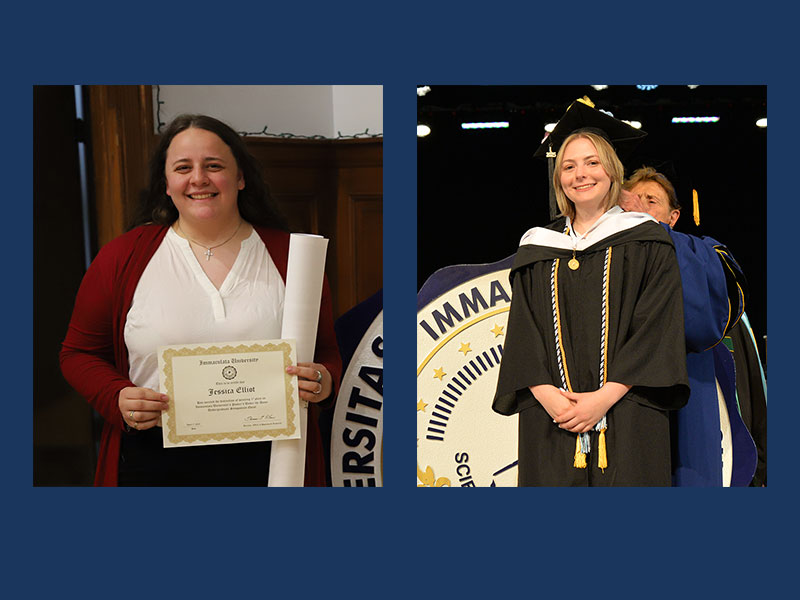
Elizabeth Miller completed the IU Honors Program and received the Sister Marian William Hoben Medal for English during the 2025 commencement ceremony.
High school students are invited to the IU Honors Program based on strong academic performance—typically a 3.5 GPA or higher—and other indicators of achievement, such as strong test scores or class rank. Immaculata freshmen in their first or second semester with a 3.5 GPA may also be invited, as are freshmen and sophomore transfer students who have completed 24 credits and who have at least a 3.5 GPA. Students who transfer into Immaculata as juniors and are unlikely to complete the full honors program will instead be invited to join the Honors Congress, an affiliate program that grants access to all honors courses, programs, extracurricular and co-curricular activities, and priority registration.
Grounded in the liberal arts, the IU Honors Program invites students to explore personhood and community, think creatively and critically, lead and serve for the common good, engage in cross-cultural dialogue and contribute to a community of multidisciplinary scholars.
To put these principles into practice, Weikert collaborates with Immaculata faculty from a wide range of departments to design engaging, interdisciplinary coursework to complete the 18-credit program. Each semester features new instructors and topics, ensuring that students experience diverse academic perspectives.
Students begin the program by taking the Honors First-Year Experience course, followed by two honors-level composition classes, two electives, and the required Honors Colloquium—a guided research project with a public presentation that usually completes the program requirements by the students’ third year.
Students are recognized for their work each year at the spring honors ceremony, receiving certificates of achievement. The recognition also appears in the commencement program and on their official transcripts.
“The IU Honors Program has encouraged me to push myself outside my comfort zone through debates and discussions.”
–Carly Katrinak
Other benefits of participating in the IU Honors Program include co-curricular and service-learning opportunities, friendships with students and faculty from a wide range of majors and priority registration each semester. Many students say the biggest advantage is the challenging classwork that makes them better students.
Junior Carly Katrinak, a double major in theology and English: professional writing, said her writing and presentation skills have greatly improved since joining the program. She has enjoyed the class discussions, especially for War Movies and The Gospel in Les Misérables.
“The IU Honors Program has encouraged me to push myself outside my comfort zone through debates and discussions,” Katrinak stated. “I’ve been exposed to viewpoints I would have otherwise been ignorant of and have learned about different religions and philosophies in greater detail.”
When Rose Lindsey ’26, an elementary education and special education major, was invited to join the IU Honors Program, she thought it would simply mean more work. Instead, she found that the program provided assignments that stretched critical thinking skills and encouraged students to think deeply and engage in productive dialogue.
“As an educator myself, I understand that the purpose of education is not a high grade or academic distinction but rather the constant growth and pursuit of knowledge,” Lindsey said. “Through the honors program, I obtained a myriad of transferable skills that not only helped me in my other classes but have also aided me in my student teaching experience and will undoubtedly help me as I enter the workforce.”
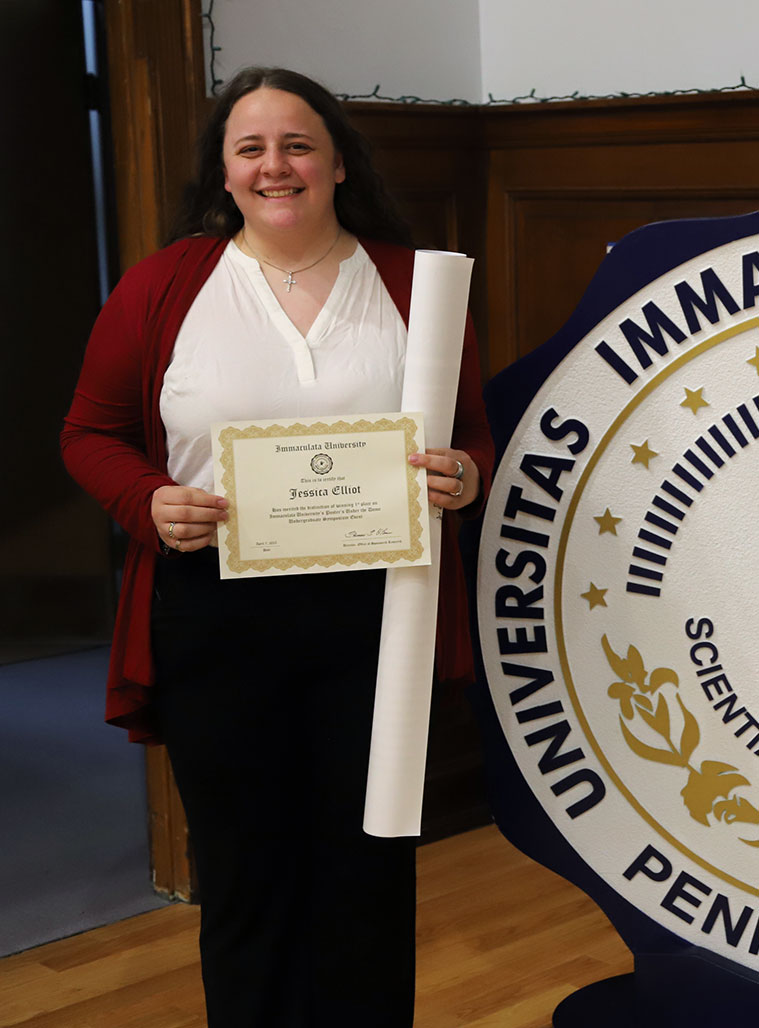
Jessica Elliot, who completed the IU Honors Program, received First Place for her research presented at the annual Posters Under the Dome in 2025.
Fellow honors student Grace Mazza ’27, a psychology major, appreciates the early registration perk, which lets her build a schedule around her interests. Like Katrinak, one of her favorite courses was War Movies.
“I don’t frequently engage in politics and history academically,” Mazza said, “so getting to explore these topics through an academic and personal interest of mine—film—has been very rewarding.”
Class discussions encourage students to identify, clarify and resolve intellectual, ethical and social questions. Weikert recalls one memorable class session in which they debated: Do zombies need to eat brains, or do they want to? Although at first, it may not seem like much of a difference, “But it really changes the moral and ethical perspectives on it,” he said.
In the Honors Colloquium, students expand on a shared topic through the lens of their major. For instance, when the theme was “Perspectives on Poverty,” education majors examined income inequality and its impact on academic achievement, nutrition majors studied how poverty—specifically food scarcity—affects long-term health, and psychology students analyzed how poverty limits access to mental health resources.
To showcase student work, Weikert is launching a new digital journal, “Labyrinth,” which he hopes to expand to other media formats. Katrinak is submitting an editorial related to what she learned in her Gospel in Les Misérables class, which will be one of the first papers posted to the journal.
Outside the classroom, honors students take part in co-curricular and service-learning projects that enrich their education and build community. Over the years, they have supported the annual campus Veterans Day recognition, organized “thank-you” card drives for veterans at the Coatesville VA facility and partnered with campus clubs on winter clothing collections.
For Weikert, that sense of community is the biggest benefit of joining the honors program. The interdisciplinary approach to courses and co-curricular activities brings students from every academic program together for meaningful discussions and shared experiences.