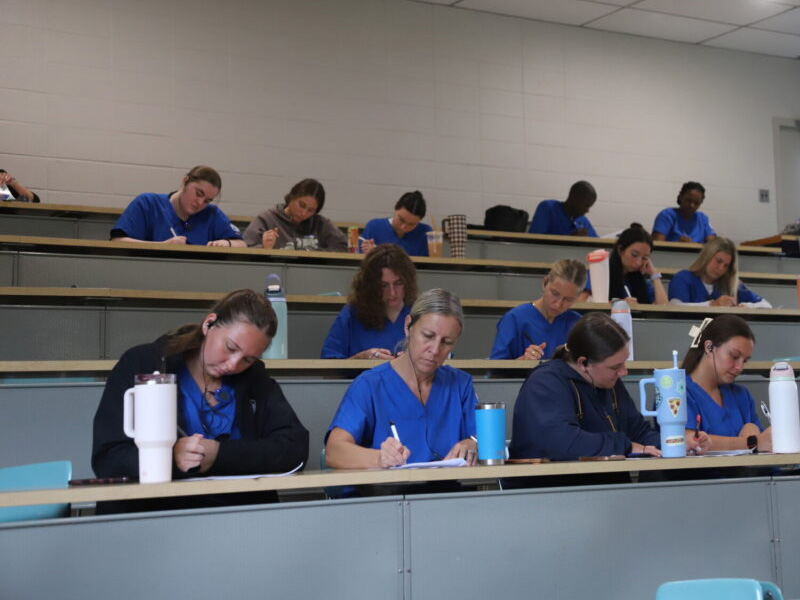
Completing everyday tasks while intrusive voices compete for your attention can make even simple activities exhausting. To help students better understand that experience, Immaculata University’s second-degree, accelerated nursing students participated in a Hearing Voices Simulation, where they experienced some of the challenges people living with schizophrenia may face during everyday activities.
According to the National Institute of Mental Health, schizophrenia is a serious mental illness that affects how a person interprets reality and may include symptoms such as auditory hallucinations. In the United States, approximately 3.5 million adults live with schizophrenia or related schizophrenia spectrum disorders.
As part of the Hearing Voices Simulation assignment, students wore headphones during a 45-minute session, where they were required to complete activities including filling out a job application, completing medication calculations, counting to 30 by threes and brief mental status examination while listening to the simulated voices. The voices often said disturbing statements, such as “You suck.”
Mindy Tait, Ph.D., MBA, CRNP, FNP-BC, chair of the University’s Division of Nursing, noted that the goal of the activity was to provide students with a glimpse of some of the challenges people living with schizophrenia may experience. She noted that the experience offered a level of understanding that students could not gain by simply observing a patient living with schizophrenia during their clinical rotations this summer in behavioral health settings.
Students listened to simulated voices while responding to questions.
“By placing students in the shoes of someone experiencing mental health distress, we cultivate an immediate, visceral understanding of patient vulnerability,” stated Tait.
During the debriefing session, Molly Clawson ’27 shared that she remembered hearing voices that commanded action, such as: “Don’t say that.” Clawson said the most surprising part was the silence between the voices. “When there was a lull, [concentrating] was harder because you were constantly expecting [voices]. When you can hear the voices, you can tune it out.”
Other students described gradually becoming accustomed to the voices, working harder to concentrate on assignments, struggling to organize their thoughts and being unable to turn the voices off.
Danielle Downing, MSN, professor and assistant director of Laboratory/Simulations and Clinicals, led the debriefing portion after the simulation concluded, along with other Immaculata nursing faculty members and staff. Downing asked the students to share both emotional and physical reactions as they progressed through the activities. Debriefing is a critical component of all simulation activities. Pamela Hudson, MBA, D.B.A., who assisted with the mental status exam station, noticed that most of the students were distracted by the voices and struggled to count to 30—especially once they got into the 20s.
Taneesha Williams ’27 had worked at Montgomery County Emergency Services where she interacted with patients living with schizophrenia. She found it interesting to learn how newly diagnosed patients coped with the voices. For example, she recalled one patient who coped by pretending to talk on the phone when responding to the voices he heard.
Tait believes that regardless of the nursing specialty students pursue after graduation, they will encounter patients with psychiatric conditions in hospitals, clinics and community-based settings. She said the simulation will help prepare them to provide compassionate, patient-centered care throughout their careers.
Although the voices stopped when the headphones came off, students left with a deeper understanding of the daily challenges many people living with schizophrenia face and the skills to respond with greater empathy and confidence when caring for these patients.