Immaculata News
Immaculata University Students Explore the Science of Taste
Quick Takes:
- Why does taste matter? For patients undergoing chemotherapy, food acceptance can be an important part of meeting nutritional needs.
- Heather Smart’s sensory science research examines how flavor, texture, color and aroma influence people’s willingness to eat.
- Did you know people may eat more potato chips when the sound of crunching is louder? Smart shared how even sound can influence food consumption.
- From diet soda to nutritional supplements, sensory science helps food developers understand what makes products appealing to consumers.
For cancer patients undergoing chemotherapy, eating can become a challenge. Nausea, vomiting and other treatment-related side effects can make food unappealing, even when proper nutrition is essential to recovery. In fact, approximately 80% of cancer patients receiving chemotherapy experience nausea and vomiting.
That’s where sensory science comes in.
During a recent campus presentation, Heather Smart, DHSc, MS, RDN, LDN, BCBC, assistant professor and director of Immaculata University’s Didactic Program in Dietetics, explored how sensory and consumer science can influence food acceptance and improve nutritional outcomes.
“People often don’t want to eat the food that we want them to eat throughout treatment and recovery,” Smart said, explaining that nearly everything nutrition professionals do has a sensory consequence.
Sensory science involves evaluating a product’s characteristics through sight, smell, taste, touch and hearing. Trained sensory evaluators assess these attributes objectively in a controlled environment, while consumer research focuses on whether people like a product, would purchase it and how much they would pay.
Although the two disciplines have different objectives, they work together to help developers create products that people want to consume.
“As a sensory scientist, I don’t care if you like the product or not,” Smart explained. “I just want to know what you taste.” On the consumer research side, however, preferences matter. “I do care if you like it and I want to know how much you would pay for it,” she said.
Turning Research Into Better Nutrition
Smart has spent the past several years researching and developing popsicles that could help young cancer patients manage chemotherapy-induced nausea and vomiting.
Preliminary market research revealed that many people undergoing chemotherapy prefer frozen desserts and snacks.
But creating a product that patients want to consume requires more than finding a flavor they enjoy.
“Taste drives acceptance; acceptance drives adherence,” Smart said.
If a popsicle tastes unpleasant, patients may refuse to eat it again. The same principle applies to medications and oral nutritional supplements, which provide important nutrients but can be difficult for patients to tolerate.
Smart noted that research indicates approximately 50% of oral nutritional supplements fail, largely because of poor taste. Identifying the sensory attributes that cause rejection can help researchers reformulate or prepare supplements to improve acceptance without changing their nutritional composition.
Certain vitamins and minerals present particular challenges because of their naturally unpleasant flavors. B vitamins, for example, can taste bitter, while vitamin E may have fatty, unpleasant characteristics.
Sensory scientists can counteract these flavors by incorporating ingredients that balance or suppress undesirable tastes. Salt can reduce bitterness, while sucrose and citric acid can help mask bitter notes, particularly in calcium-containing products.
Smart offered over-the-counter antacid tablets as an example. The product’s primary ingredient, calcium carbonate, has a chalky taste. Manufacturers use concentrated flavors, including peppermint and fruit extracts, to mask that taste and make the product more appealing.
Taste, however, is only one part of the equation. Texture, temperature and even the physical sensations associated with food can influence whether someone enjoys a product.
The Science Behind What We Like
Smart explained that food manufacturers consider texture when developing products. Sour gummy candies, for example, have rough surface textures that can influence how consumers perceive their sourness.
Temperature and carbonation also affect taste perception. Manufacturers can use these characteristics to enhance the appeal of reduced-sugar beverages, including diet sodas, without relying entirely on sugar for flavor.
Another important factor is chemesthesis, the body’s sensory response to certain chemical compounds in foods. Smart described how eating hot peppers or hot sauce can activate these sensory pathways, producing a burning sensation and sometimes causing people to feel warm and sweat. Capsaicin, the compound responsible for the heat in chili peppers, activates certain receptors, which are also involved in detecting heat. This explains why the brain interprets the sensation as burning even though the food isn’t actually hot in temperature.
These sensory characteristics helped to inform the decisions Smart and her colleagues made when developing popsicles for young cancer patients.
Developing a Popsicle Patients Will Enjoy
Drawing on her nutritional expertise, Smart considered more than flavor when selecting ingredients and colors for the popsicles. She avoided foods with red, purple and certain green hues, as these colors could make it more difficult for patients or caregivers to distinguish the popsicle’s color from concerning bodily fluids if a patient becomes ill.
Smart evaluated more than 100 recipe variations and personally sampled more than 1,000 popsicles. Eventually, she narrowed the options to five flavors: apple ginger, chamomile, peppermint, cucumber melon and plain.
After extensive consumer testing, Smart compiled and analyzed participants’ descriptions of each flavor’s taste and aroma. Chamomile emerged as the favorite, followed by peppermint, apple ginger, cucumber melon and plain.
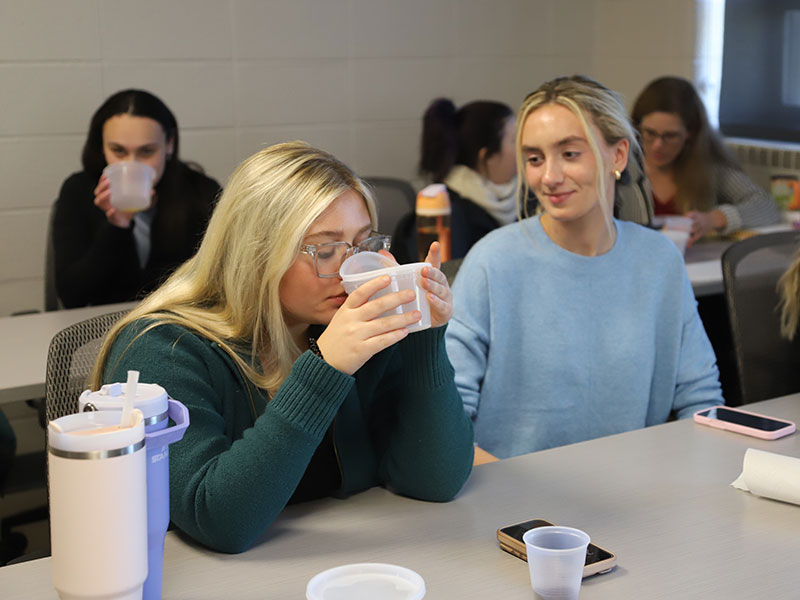
To give attendees a firsthand experience with sensory evaluation, Smart also conducted an in-class aroma test. Participants smelled two unidentified scents — lemon and rose — and described their impressions before indicating which they preferred.
Lemon won by a large margin. Participants frequently described the scents as “clean” and “grandma’s perfume,” respectively.
A Growing Field With Real-World Applications
Smart’s presentation attracted graduate students, faculty and administrators interested in how sensory science can advance dietetics practice.
Mallory Hampton, a student in Immaculata’s Master of Science in Clinical Nutrition with Dietetic Internship program, appreciated the practical examples Smart shared, particularly those demonstrating how palatability affects the effectiveness of oral nutritional supplements.
“She’s right, people won’t be consistent if they’re not actually enjoying it,” Hampton said. “So, using research to increase palatability [of] formulas that are medically relevant is super important.”
Hampton is currently completing her internship and community rotations, gaining supervised, hands-on experience in nutrition and dietetics settings.
As future dietetics professionals like Hampton enter the field, they will encounter emerging technologies that could further transform food and nutrition research. Smart discussed how artificial intelligence, virtual reality and augmented reality are providing researchers with new ways to evaluate consumer preferences and predict product success.
Ultimately, sensory science goes beyond taste to understand what makes people want to eat the foods their bodies need. Smart’s research illustrates how that knowledge can help nutrition professionals and food developers better address the challenges of food acceptance, particularly among patients whose medical treatments affect their ability or willingness to eat.