Music Therapy, M.A., M.M.T.C.
Gain the knowledge, skills and qualities to practice music therapy at an advanced level in a range of clinical settings.
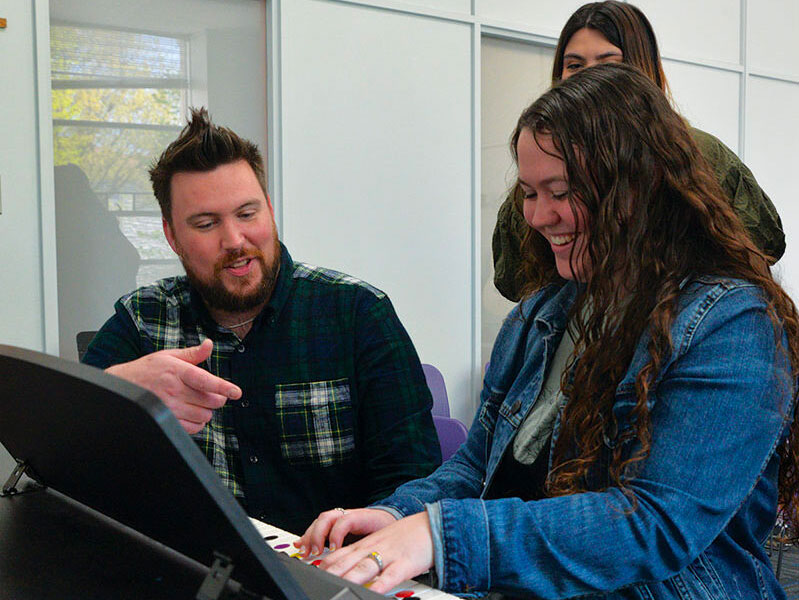
Immaculata’s master’s programs provide extensive training in the musical, clinical, and theoretical components of music therapy, allowing you to use your music skills to help people improve their quality of life. Courses feature student-centered, individualized learning with a focus on direct application of theory to clinical practice.
- The Master of Music Therapy and Counseling (M.M.T.C.) emphasizes psychotherapeutic practices that integrate mental health counseling and music therapy.This degree fulfills the academic requirements to become a Licensed Professional Counselor (LPC) in Pennsylvania.
- The Master of Arts in Music Therapy (M.A.M.T.) focuses on professional practice in music therapy.
If you have a bachelor’s degree outside of music therapy (e.g. B.Mus., B.A. in Music, B.A. in Psychology with music studies), choose from these program tracks:
- Equivalency M.M.T.C. (60 credits)
- Equivalency M.A.M.T. (60 credits)
Learn More
Fill out this form to get more information about this graduate program.
These equivalency programs provide the coursework needed for equivalent music therapy training without having to earn a second bachelor’s degree. You will take graduate-level courses and gain both the bachelor’s-level professional competencies and advanced competencies required by the American Music Therapy Association.
The 48-credit advanced program (available as part of either the MAMT or MMTC degree) is designed for accredited music therapists (MT-BC) who wish to develop advanced skills in music therapy clinical practice.
At a Glance
Program: Master of Arts or Master of Music Therapy and Counseling
Audience: Graduate students
Format: Face-to-face classes
Next Start Date: August, 2026
Time to Completion Varies by program (4-8 semesters)
“I was able to grow interpersonally, enhance my clinical skills and refine my approach to clinical practice, making my experience in the graduate Music Therapy program a truly invaluable one.”
Kathleen Summers
Music Therapy Programs at Immaculata
Music Therapy Equivalency Programs
The equivalency programs provide the coursework needed for equivalent music therapy training without having to earn a second bachelor’s degree.
If you have a bachelor’s degree in music therapy and board certification as a music therapist (MT-BC), choose one of the advanced tracks.
Equivalency M.A.M.T. and M.M.T.C.
Our equivalency programs offer a graduate-level education in music therapy that allows you to become a practicing music therapist during your course of study. After your internships, you are eligible to take the board certification exam to become a music therapist (MT-BC) and complete your remaining semesters as a practicing professional. In this advanced portion of the program, you apply your classroom learning directly to your clinical practice, offering you a unique opportunity for supported learning as you begin your career.
Whether you have a music degree or need to take music prerequisite courses, we welcome students with diverse academic backgrounds. Prerequisite (or corequisite) courses include:
- Music courses in theory, aural skills and history
- Competency in guitar, piano and voice
- Applied music study with ensemble experience
- Basic statistics course for the social sciences
- Human anatomy course
- World music course
Our graduate program prepares you to work with many different client groups, such as:
- People with special needs or disabilities: children or adults with autism spectrum disorder or developmental or intellectual differences
- Medical settings: neurological or physical rehabilitation, oncology, pediatrics
- Mental health settings: inpatient or partial hospitalization, correctional and forensic facilities, substance abuse treatment centers
- Community and school settings: centers for at-risk adolescents, wellness centers
- Assisted living and end-of-life settings: skilled nursing facilities, hospice, palliative care
Equivalency Program Highlights
- Take individual lessons in guitar, voice and piano to develop your music therapy skills and repertoire.
- Complete 200 hours of faculty-supervised fieldwork in a minimum of three different clinical settings.
- Learn to use different kinds of music therapy experiences with clients, such as singing, playing instruments, improvising, writing songs, listening to music and verbal discussion.
- Prepare for the music therapy certification exam through workshops and materials. Our students’ 2023 first-time certification exam pass rate was above average at 75%, compared with a national average of 69%.
- Obtain your board certification during your coursework and begin your music therapy career before graduation.
Required Courses
- MUT 500 Theoretical Orientations to Music Therapy Clinical Practice
- MUT 502 Theories and Processes in Didactic/Developmental Music Therapy
- MUT 504 Theories and Practices in Medical Music Therapy
- MUT 506 Theories and Practices in Psychiatric Music Therapy
- MUT 608 Ethical and Professional Orientation in Music Therapy
- MUT 609 Music Therapy Practice with Diverse Populations
- MUT 512-514 Clinical Training: Integrating Theory & Practice
- MUT 524 Graduate Internship I
- MUT 525 Graduate Internship II
- GEN 501 Human Development
- COUN 600 Research & Program Evaluation
- COUN 604 Group Process
- COUN 608 Psychopathology
- COUN 609 Career and Vocational Counseling
- COUN XXX Counseling Elective
ADVANCED MUSIC THERAPY CLINICAL, PROFESSIONAL, MUSIC & RESEARCH SKILLS (Choose 13 credits from the following)
- MUT 600 Music and Imagery in Clinical Practice
- MUT 601 Advanced Resource Development
- MUT 603 Clinical Improvisation in Music Therapy
- MUT 606 Songs in Psychotherapy
- MUT 613 Music Biofeedback Research
- MUT 614 Grant Writing and Program Development in Music Therapy
- MUT 617 Mindfulness and Self-Care
- MUT 626 Vocal Psychotherapy
- MUT 642 Clinical Assessment in Music Therapy
- MUT 643 Integration of Verbal and Music Skills in Music Therapy
- MUT 645 Advanced Technology for Music Therapy
- MUT 646 Music Therapy Research
ADVANCED CLINICAL TRAINING
- MUT 621 Advanced Music Therapy Internship
- MUT 625 Clinical Supervision and Administration
- MUT 630 Advanced Music Skills for Therapy
- MUT 599 Comprehensive Exam in Music Therapy
- MUT 690 Culminating Project in Music Therapy
Students who require support to pass the diagnostic functional music skills proficiency examination must complete one or more of the following courses (on a repeatable basis).
- MUT 530: Music Skills for Therapy – Piano
- MUT 532: Music Skills for Therapy – Guitar
- MUT 534: Music Skills for Therapy – Voice
Advanced M.A.M.T. and M.M.T.C.
The 48-credit degree program is specially designed for music therapists (MT-BC) who wish to develop advanced skills in therapeutic techniques for medical, mental health, and didactic settings.
Program Highlights
- Opportunities for study in related fields including counseling and healthcare administration, including an optional dual degree in music therapy and clinical mental health counseling
- Tuition discount for active fieldwork supervisors of Immaculata University students
- Opportunities for low-residency completion to accommodate the needs of working professionals
- In-depth training in client assessment and cultural diversity
- Advanced clinical supervision focused on the application of theory, clinical approaches, and supervision techniques
- Development of advanced music skills through coursework and individual lessons
- Opportunities for self-reflection and the development of your unique talents
Required Courses
Required Courses (LPC Concentration)
- MUT 608 Ethical and Professional Orientation in Music Therapy 2
- MUT 609 Music Therapy Practice with Diverse Populations 2
- GEN 501 Human Development 3
- COUN 600 Research & Program Evaluation 3
- +COUN 604 Group Process 3
- +COUN 608 Psychopathology 3
- +COUN 609 Career and Vocational Counseling 3
- +COUN XXX Counseling Electives 9
+ Students pursuing the professional track (not seeking their LPC) may substitute these courses with electives.
ADVANCED MUSIC THERAPY CLINICAL, PROFESSIONAL, MUSIC & RESEARCH SKILLS (Choose 14 credits from the following)
- MUT 600 Music and Imagery in Clinical Practice 2
- MUT 601 Advanced Resource Development 2
- MUT 603 Clinical Improvisation in Music Therapy 2
- MUT 606 Songs in Psychotherapy 2
- MUT 613 Music Biofeedback Research 2
- MUT 614 Grant Writing and Program Development in Music Therapy 2
- MUT 630 Advanced Music Skills for Therapy 1
- MUT 642 Clinical Assessment in Music Therapy* 2
- MUT 643 Integration of Verbal and Music Skills in Music Therapy* 2
- MUT 645 Advanced Technology for Music Therapy 2
- MUT 646 Music Therapy Research 2
- *Course required for LPC Track
Advanced Clinical Training
- MUT 610 Advanced Music Therapy Practicum 1
- MUT 621 Advanced Music Therapy Internship I 1
- MUT 622 Advanced Music Therapy Internship II 1
- MUT 599 Comprehensive Exam in Music Therapy 0
- MUT 690 Culminating Project in Music Therapy 3
Frequently Asked Questions
Contact
Corey Olver, PhD, MT-BC, LPC, ACS
Director of Graduate Music Therapy, Associate Faculty
Related Music News

The campus community came together to honor Stephen Moore, the cousin of Melissa Rice ’09. Music students created a professional recording of his rap song, “Love, Moore.”
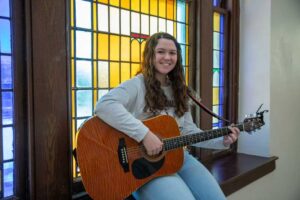
“Music is one of my main sources of comfort,” Bree reflected. “It grounds me and helps me grow and connect to other people.”
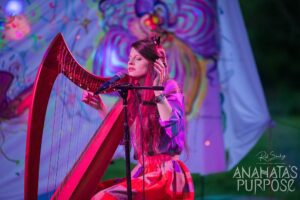
Having the opportunity to continue practicing music therapy while touring and performing is the best of both worlds for Gallagher.